
Establishing a well-defined scheme on both offense and defense is essential for creating a team identity. This identity should be tailored to your team’s strengths and personnel. With a wide range of modern strategies available, we will focus on the most effective and widely adopted schemes in today’s professional and collegiate basketball. While these systems may initially appear complex, consistent practice and repetition can make them accessible and impactful at any level of play.
Terminology
Every great coach will always clearly define his or her terminology early. The entire team must understand exactly what is being told, so they can execute. They must trust and believe in the system. No matter your role know the terms!
Offensive Concepts
- Set – Scripted, predetermined plays in the half court, often used to control tempo or create scoring opportunities in late-game situations.
- Concepts – Offensive fundamentals, including structure, formations, flow, cutting, screening, and actions.
- Action(s) – Specific movements (screens, cuts) with multiple offensive options.
- Flow – a term used to describe a free “flowing” offense that seamlessly “flows” into action or creating the next advantage.
- False Action – Decoy movements designed to disguise offensive concepts and manipulate defensive positioning.
- Screen Options – Reads and decisions made by the offense based on defensive coverages for on-ball and off-ball screens.
- Transition Break – Fast-break offense after a live ball turnover or rebound, creating quick advantages, mismatches, and attacks. Sometimes referred to as “primary break”.
- Primary Action – First action after transition, different from a fast break. Primary action sets up offense and flows into secondary action.
- Secondary Action – Continuation actions following a break to sustain offensive flow.
- Exit Play – Designed plays for under 12-second shot clock situations to create quick scoring opportunities.
Defensive Concepts
- Scramble Defense – Defense reacting after help is initiated, forcing defenders to recover and rematch in disadvantage situations.
- Primary Defender – On-ball or strong-side defender responsible for direct coverage.
- Secondary Defender – Weak-side or help defender providing support coverage.
- “Dominoes” – Offensive advantage forcing the defense into a scramble after breaking down the primary defender.
- Walling Up – Vertical contest by a defender jumping straight up (A-to-A jump) to avoid fouls while protecting the rim.
- Gap Defense – The gap = the driving lane, and gap defense = sitting in the gap to force a kick out or stunting the gap forcing a ball handler decision
- Pressure Defense – Ball pressure or off ball denials. Being up the line or off the line.
- Trap – Any hard double team off a screen, dribble, or pass.
Screen Coverages
- Tag Man – Help defender responsible for tagging the roller during ball screen defense.
- Over/Under Drop – Ball screen coverage where defenders go over or under screens, and the big drops to protect against rollers.
- Hedge – Aggressive ball screen coverage where the big doubles or traps the ball handler.
- Soft Hedge – Soft double forcing ball handler away from basket.
- Hard Hedge – Hard double not trapping, but forcing ball handler further from basket, and ultimately passing.
- Blitz – Most aggressive hedge, trapping the ball handler.
- Weak – Forcing away from the screen or ball handler to weak hand.
- Ice – Forcing the ball handler to the sideline, away from the screen.
- Top Lock – Denying the offensive player the top-side cut, forcing a backdoor option.
- Lock and Trail – Staying attached at the hip to force shooters to curl instead of using the screen cleanly.
- Flat – Over/under coverage on off-ball screens.
- Take – Switching defensive assignments in man-to-man coverage.
Screening and Cutting
There are countless variations of screens, rolls, and cuts, but their effectiveness depends on the offensive player’s ability to “read” the defense. Teaching this skill can be challenging, often summarized by the phrase, “don’t be a robot.” Many modern players need to relearn the fundamentals—how to properly set screens, cut, and roll. Once these basics are mastered, reading screens becomes more intuitive. Offenses must provide players with options, as options create solutions. Just as defenses adjust to counter options, offenses must adapt to stay one step ahead. Here’s a simple example of basic screening, reading, and cutting.
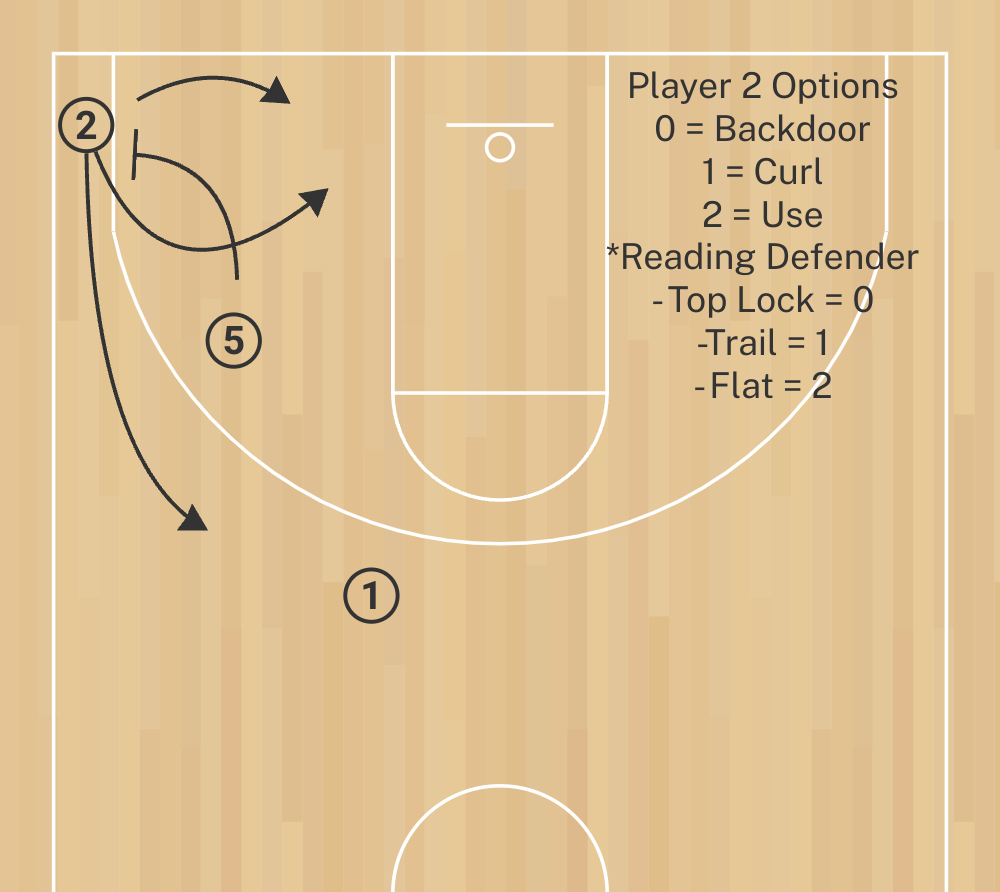
*Screening/Cutting Tip – Screeners (player 5) angle your back in the direction you want the player to use it, and cutters (player 2) put two hands on screener to create space.
A key challenge in coaching screening and cutting is predetermining reads. Predetermined decisions make players predictable and easy to guard. Instead, players should read the defensive coverage in real-time, making decisions based on the situation. No two plays are identical, so understanding screen options is essential for making the right decision.
The Family of Four
The 4 main screens (off the ball) in basketball are back, cross, down, and flare screens. Out of these screens there are many subtypes used for both action and sets.
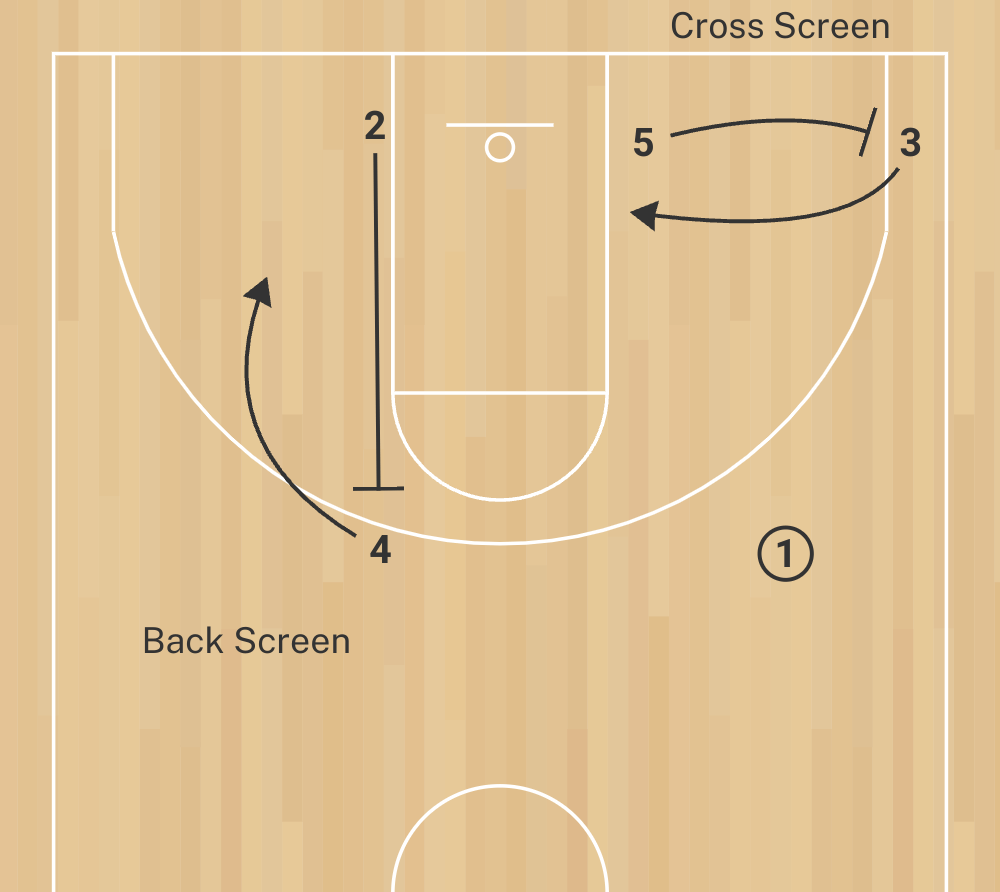
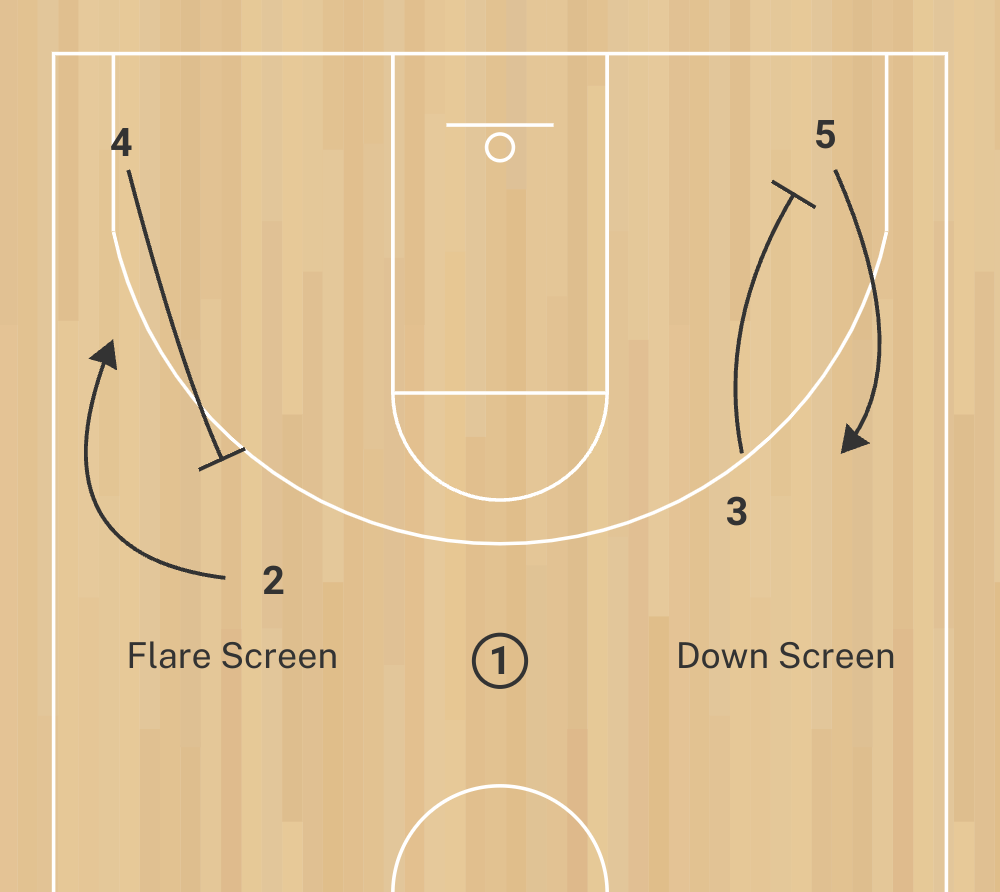
Reading, Screening, and Cutting will only be possible if there is effective spacing on the court. Different formations can create different action and manipulate defenses. Screening and cutting is only possible with spacing!
Types of Offensive Formations (Spacing)
- 5 Out
- 4 Out 1 In
- 3 Out 2 In
- 4 High
- 4 Low
- Horns
I think the formation of offense is sometimes more important than the sets or plays themselves. Having numerous “sets” out of different formations is virtually impossible to scout. Formations are important, but clearly defining positions on the court is even more important. There will be certain players you want in corners, slots, dunker, or post.
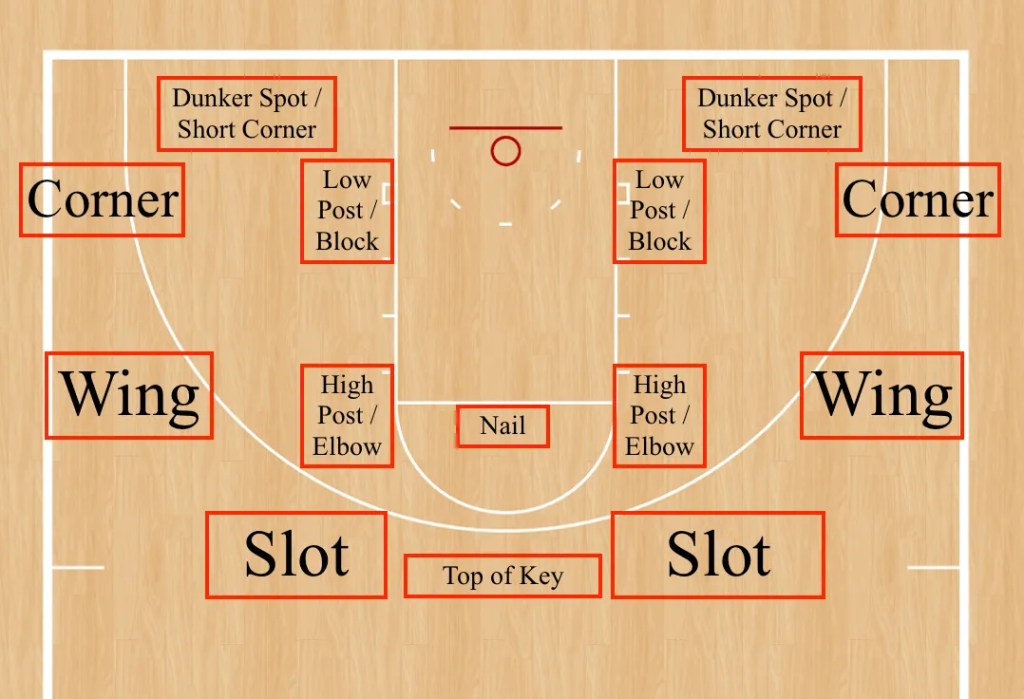
The type of offense you run varies based on the strengths of your players. Putting them into positions where they will play to their strengths. For example if your team has a dominate post player, the offense should have a focal point of getting to the low post/block area. Another example is a perimeter oriented team with shooters and slashers – with lots of space, motion concepts, and screens. All teams must utilize the corners, wings and slots to create advantages. Always play to your strengths. If you want to learn more about advanced offensive action follow the link below. Advanced offense combines sets and actions into a free flowing system.
Types of Screen and Cuts (Actions)
Ball Screens (On-Ball Actions)
- Ball Screen – Any screen set for a ball handler.
- Twist – Screener changes angle of screen
- Drag – Transition ball screen on the side.
- Flat – Screener faces or has their back to the ball handler.
- Slip – Quick cut to the basket, especially when the defense switches.
- Roll – Screener rolls to the basket for a pass.
- Short/Long Roll – Adjusts roll distance based on defensive coverage (hedge/blitz/drop).
- Pop – Screener pops out behind the defense instead of rolling.
- Shake – Lifting or replacing when the tag defender helps on a ball screen.
- Ghost Screen – Fake screen where the screener slips out to the perimeter.
- DHO (Dribble Handoff) – Handoff action acting like a ball screen.
- Zoom (Chicago) – Down screen into a dribble handoff (DHO).
Off-Ball Screens
- Down Screen – Vertical screen off the ball.
- Away Screen – Screen set away from the ball.
- Back Screen – Screen set on the back of a defender
- Stagger Screen – Double away screen, sometimes run as a triple or along the baseline.
- Flare Screen – Screen moving away from the ball.
- Cross Screen – Horizontal screen.
- Slice Screen – Diagonal screen.
- Flex Screen – Block-to-block cross screen.
- Screen-the-Screener – Cross screen into an away screen.
- Chin Screen – Back screen on the weak side elbow or slot
- Rip Screen – Guard setting a back screen on a big
Cuts (Player Movement)
- Back Cut – Cut behind the defense.
- Face Cut – Cut in front of the defense.
- UCLA Cut – Guard cuts around a big’s elbow screen (subtype of back screen)
- Iverson Cut – Wing players exchange over or under screens.
- V-Cut – Quick movement to set up the defense and create space.
- Twins Cut – Cross-matching off the back of the offense.
- Veer Cut – Used as either a screen or cut.
- Shake Cut – Replacing or lifting based on defensive help during ball screens.
- “45” Cut – Wing cut on a baseline drive.
- “Finger” Cut – Baseline cut on a wing drive.
- “Get” – a pass to a big and guard gets immediate hand off or pitch back
- Boomerang – a pass to a teammate and immediate pass back for live dribble
Special Screening Sets
- Horns – Double screen with a shooter and roller at the top of the key.
- Spain – Also called stack, ball screen followed by back screen on the screeners man.
- Roll Replace – Shooter starts ball side block, and 5 man sets screen rolling with shooter replacing the ball handler.
- Spread PnR – Type of pick in roll used in half court, spread means all players outside 3pt line. Space is critical.
Concepts and Actions
This is my favorite part of basketball—”just let us play.” This popular quote captures a mindset embraced by many teams during practice. Effective basketball players are developed through concepts and actions, enabling them to operate within a structured framework without relying on set plays.
What are concepts and actions? The foundation of the offense relies on structure, but within the structure there are certain concepts – type/timing of cutting, use of on/off ball screening, dribble hand offs, exit plays, and structure…
So, what is structure? It can take different forms—such as formations (e.g., 5-out or 4-out, 1-in), playing styles (e.g., transition-focused or pace-controlling), or most importantly the actions you run. Modern basketball is increasingly played in transition, with fewer half-court sets. As a result, teams must be prepared to understand concepts allowing them excel in unscripted actions.
Unscripted basketball focuses on freelancing and exploiting advantages, whether through matchups, dribble penetration, or triggering help defense. Once an advantage is created, players flow into “dominoes”—seeking the next opportunity through ball movement or penetration, ultimately aiming for the best shot available as the defense scrambles. This style relies on minimal play-calling, emphasizing players’ ability to make instinctive basketball decisions. Unscripted basketball fosters creativity and confidence, equipping players to adapt and excel in the dynamic flow of the game.
Scripted basketball emphasizes discipline and structure, where decisions are guided by clearly defined rules and patterns. In contrast, unscripted basketball allows for greater player autonomy and requires adaptability and decision-making in real time. A coach’s role in a scripted system is to implement sets, quick hitters, or continuity offenses that offer multiple options while maintaining flow and consistency. These sets should align with the strengths of the players and the specific game situation, enabling the team to execute effectively. The goal is to design actions that create as many options as possible, empowering players to make the right decisions within the framework of the system.
Every coach will design a system that best suits its players, but understanding that the game is played in transition more and more requires more unscripted thinking. But there is a healthy balance between freelance action and predetermined set plays. Full list of sets below.
Defensive Schemes
Without getting stops on the defensive end the pretty X’s and O’s of offense will never be possible. Having a clear identity on the defensive end of the floor will elevate your team from being a playoff contender to real champions. Defense comes first when establishing a championship team.
Defense is all about understanding your teams athletic capabilities. Do you have ball pressure guards, or an elite rim protector. Will you be hard deny on the perimeter or heavy gap on drives? Any style can be interchanged or adjusted throughout the game. So as a coach teaching the principles of defense is critical.
Principles and Terminology
- Ball Pressure – Full/Half court pressure of the primary ball handler.
- Guarding The Ball – After the initial pressure is broken down, the ability to stay in front of the ball forcing the ball to stay on one side of the floor.
- Help Defense – when guarding the ball help comes when the ball handler has his chest by the primary on ball defender.
- Mig – The furthest defender from the ball.
- X-Out – The help behind the Mig, “the help the helper”.
- Contesting Shots – Great defenses contest every shot and force difficult unassisted 2 point jumpers.
- Man-to-Man – Goal is to create ideal matchups that shut down opposing teams best players (vanilla, high pressure, heavy gap, “take”.)
- “On the Line” – Means your defensive position is such that you can see your man and the ball, and your body is directly on that imaginary line usually with chest toward the player, and head toward the ball with arm up in the passing lane, in a “full denial” situation.
- “Up the Line” – Means you are in a position backed off from this imaginary line, toward the basket, in a position where you can see both ball and your man, prevent the “back-cut”, and yet be able to force the ball-handler to pass away from your man. The farther apart the ball-hander and the wing player are, the more the defender can drop back “up the line”, and still be in position to intercept or deflect the pass.
- Boxing Out – Something every player should do as a shot goes up blocking out your opponent creating a rebounding pocket.
Types of Defense
Man to Man – Within man to man there are different styles and coverages. I always will label “vanilla” as the base defense, which in this case will be heavily influenced by “no middle” principles. Again “vanilla” can be defined or labeled any way to fit strengths of your team.
- Vanilla – Typically there is less ball pressure than in “high pressure”, but more than “heavy gap.” Vanilla gives players options to cover opposing sets/actions in different ways. The options off the ball in vanilla also vary depending on the personal of the opposing team. Vanilla and the base defense will always be predicated on the personal of the opposing team.
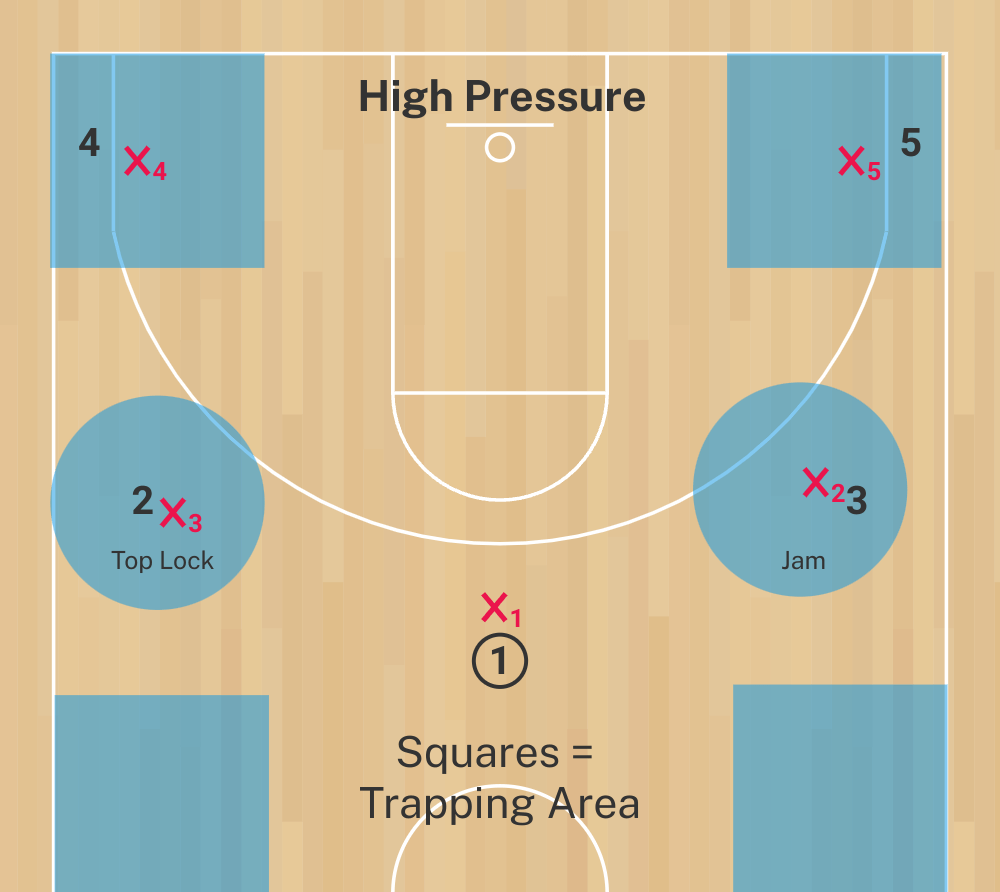
- High Pressure – Is a principle within man-to-man defense. Here the goal is to constantly pressure and turn the ball handler ball in (full/half court). The secondary defenders are in full denial and up the line. Top Lock and Jamming are two off ball coverages. This defense forces opponents into isolations – so you must guard the ball and contest every shot. Pressure defense also allows your team to extend the defense in to the back court. The issue with running high pressure full denial is the lack of help, it requires athletes and rim protectors to transition from denying to immediate help and x-out. High level defense with intelligent defenders can run and jump or “trap” ball handlers by funneling them into the squares (diagram below).
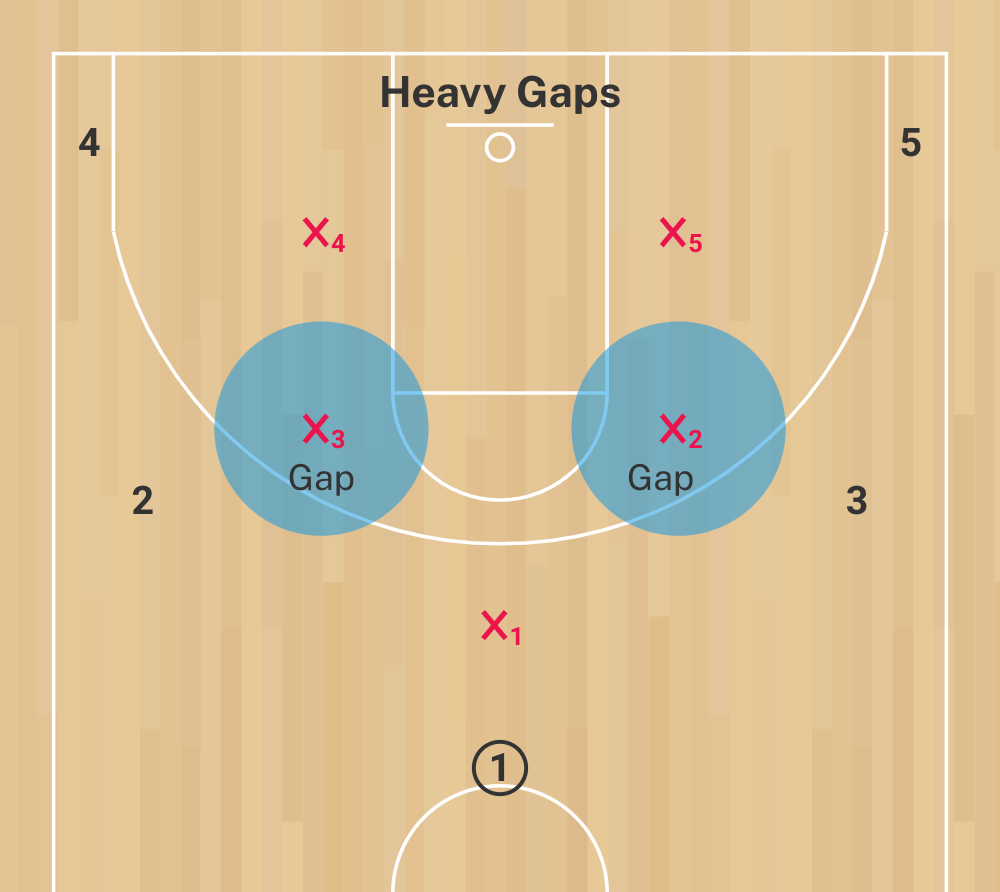
- Heavy Gap – is another principle, and not to be confused with the “pack line” defense which will be covered, because our defense = no middle. In heavy gap there is typically less pressure on the ball although you can run heavy ball pressure and have heavy gaps (which is why it is a principle and not a type of defense). The gaps refer to the nail.
Keys to Any Good Defense
- On Ball Defense – Incorporates guarding the ball, point of pick up, and contesting every shot. Without guarding the ball, whatever defense you are running will not work.
- Defensive Stance – In a low athletic stance, focused on man/ball, on the balls of your feet (never heels), and feet shoulder width apart. Keep an eye on the belly button of your opponent.
- Defensive Slides – Lateral movement or sideways run, goal is to cut off the opponent (with your feet), and keeping your chest in front.
- Close Out – method to contain the ball and not allow a shot attempt, can be taught as either choppy feet or speed stop. Two or one hand, and high or low based on matchup.
- Deny – “Jamming”, Face guarding, Up the line, on the line, or top lock are all denial coverages.
- Post Defense – Behind (allow pass), Lob (full front), three quarter (straddle),
- Ball Screen Coverage – Hedges (blitz, soft, and hard), Ice, Over/Under Drop, or Take (switch).
- Off Ball Coverage – Top Lock, Lock and Trail (chase), Take, or Flat (over/under)
Good defense relies on not fouling, taking charges, and using your chest to create “marginal contact”. Basketball is a physical game, use the rules to your advantage. Again any vanilla/base defense is predicated on the personal of the opponent.
Zone Defense – assigns players to specific areas rather than individual matchups, aiming to disrupt the opponent’s offensive flow and force adjustments. It can be implemented in various formations (e.g., 2-3, 3-2, 1-3-1, 2-2-1, 1-2-2) and even combined with man-to-man principles to form a matchup zone, which demands high defensive IQ. Some other junk defenses include a box-and-one or triangle-and-two. Attempting to eliminate the opposing teams best players and neutralizing impact.
While effective in creating chaos and slowing opponents, zone defense can be a double-edged sword. It often serves as a strategic tool when a team struggles to guard man-to-man but can leave gaps vulnerable to open shots, making it less sustainable as a primary defensive approach. For advanced defenses like the Ameoba click below
Conclusion
A great coach can establish a strong defensive identity or implement effective offensive concepts and sets, but success ultimately depends on player commitment and trust. A system is only as effective as the belief and effort of the players executing it. When players trust the coaching and play selflessly for one another, the system becomes a foundation that enables creativity, confidence, and teamwork to thrive.
 HoopTalkTV